Mountains Are Slow Waves
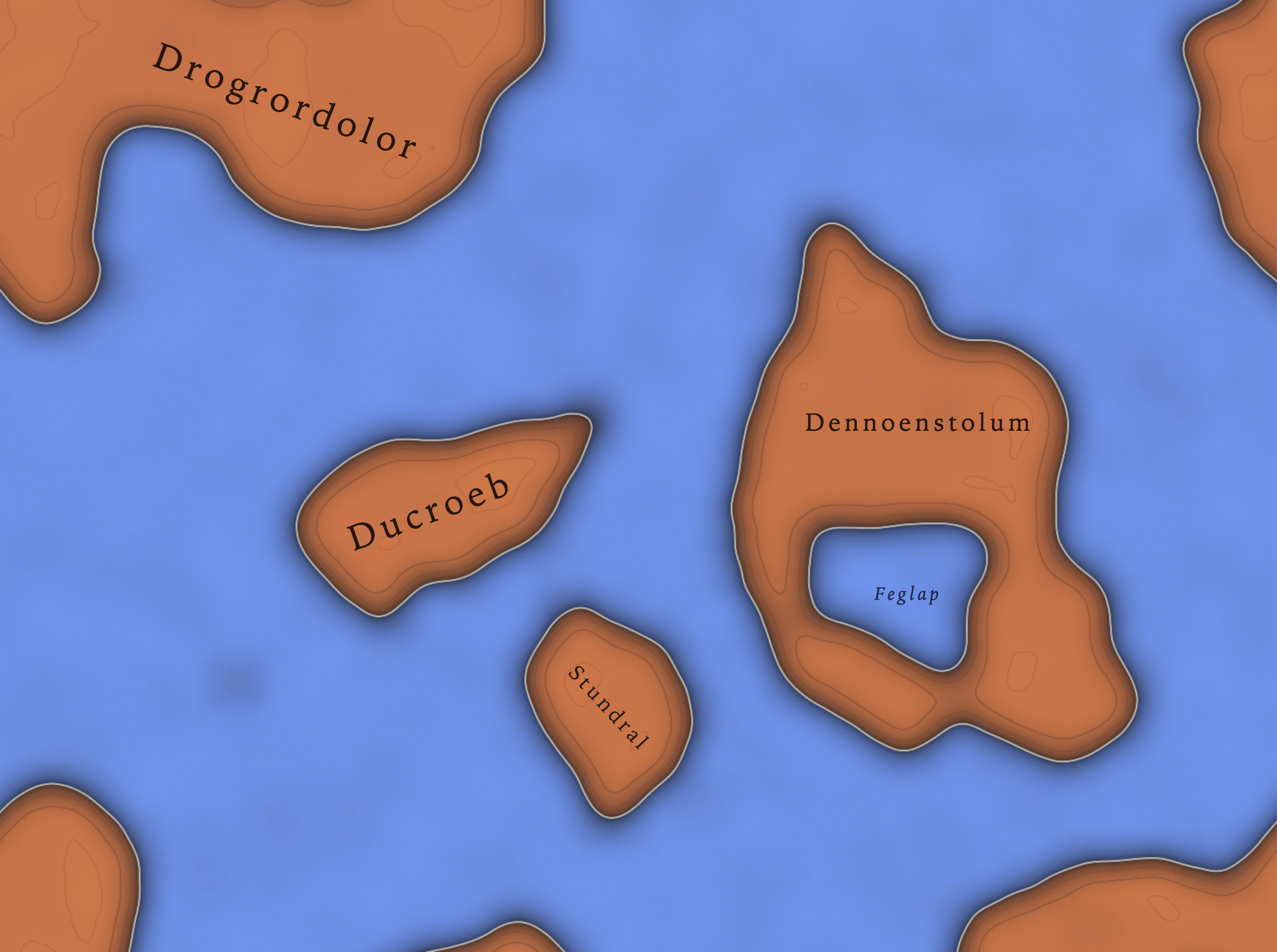
My Ising model simulation has very simple rules. There is a grid, with a spin at each point set to plus or minus. Each point interacts with its four neighbors: matching values are more favorable in terms of energy, so neighbors tend to align. Temperature adds randomness: the higher it is, the easier it is for a spin to flip against its neighbors. This gives rise to domains — regions where one of the two signs is more common.
This is one of the simplest models of magnetism. You can explain the rules in a minute and spend quite a while watching what happens. What makes it especially interesting is that you can look at it both as a physical model and more poetically, as an image of stability and change.
In the simulation, you can smoothly adjust the scale of observation. With no smoothing, you see individual spins. As you average them over wider neighborhoods, smooth domain outlines appear. The simulation starts to look like a map, with islands, straits, and continents. Places get names, and pretty soon you start recognizing them and following what happens to them.
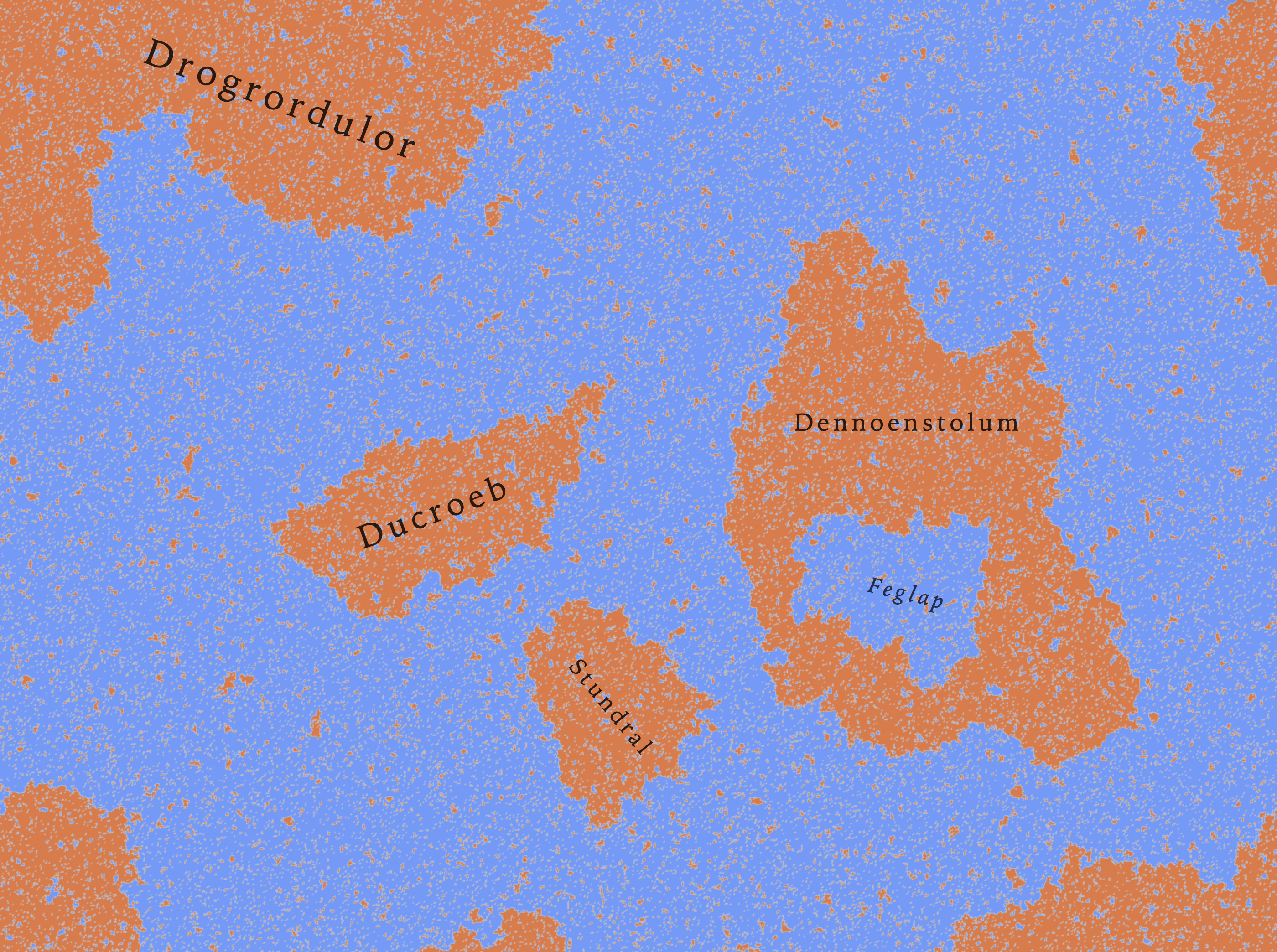
Turn off the smoothing, though, and your familiar island becomes a bubbling jumble of dots. It contains spins of both signs. They flip, gather into small groups, and break apart again. A single dot may not match the color of “its” territory at all. The clear shoreline we just saw is much harder to find at this level. Turning the smoothing back on doesn’t change the system itself: we are simply looking at it at a different “level of abstraction.” The bubbling dots and the island are two views of the same thing. At one level, it is hard to draw a boundary; at another, it is easy to see.
This is a good example of emergence. Many interacting points form a larger pattern that makes sense to treat as an object in its own right. You can recognize an island and follow it over time, even though things inside it keep changing. That doesn’t require every spin to keep its value. It is enough for the overall difference between this region and its surroundings to remain.
This is why I leave the names visible even with smoothing turned off. A name hangs over dots that no longer look much like a single island. It makes it easier to notice how naming depends on our choices: the word refers to a region we picked out at a particular scale. There are reasons for that choice, but every individual dot doesn’t have to fit it. You can see what an object is made of while remembering why we started treating it as an object in the first place.
I think this is an interesting way to look at our own boundaries, too. Things are always happening within our bodies, communities, and personalities, yet we still tell ourselves apart from others, and one thing from another. Perhaps our boundaries also “boil” when you look closely enough. That can fit perfectly well with remaining distinct and recognizable at another level.
Temperature is fun to play with, too. Cool the field down, and small regions start to disappear. The remaining ones grow, and their boundaries get simpler. The map loses detail, and the differences between smoothing levels fade away. Heat it up too much, and the old boundaries fall apart. Familiar places get lost in the flickering. Around the critical temperature, you get the most varied patterns: shapes have time to form, but they keep changing.
It is easy to see a parallel with taking all the surprises and unfamiliar things out of life. Things get calmer, but some of the detail goes away along with the worry. Too much chaos, on the other hand, breaks apart what has had time to form. It makes you want to say that a shape needs a little of that bubbling. The movement helps the map stay varied, even though any particular island may disappear. It is a curious kind of stability: things keep taking shape while everything inside and around them changes.
You can look at the field in other ways, too. As thoughts, for example: one comes together from small impressions, another takes up almost all your attention, and a third suddenly connects things that used to seem far apart. Or as languages, communities, habits. Each analogy brings out something different. You can try it on the picture and see what you notice.
You may also notice how quickly you get attached to a random patch. A moment ago it wasn’t there. Now it has a name, you recognize it, and you even try to save it with the brush. Meanwhile, its shore keeps moving. How much can it change before we stop thinking of it as the same island?
In everyday life, these changes are often hard to see. Mountains change too slowly; thoughts change too fast. Familiar words help us overlook the difference. We say “this city,” “our relationship,” “my personality,” even though a lot has changed in the meantime. Often, all we notice is that things used to be one way and now they are different. Here, you can watch one thing gradually become another.
Mountains are slow waves. We simply don’t live long enough to see them move the way we see water move. What looks still also came into being at some point, is changing, and will eventually disappear. You can get a similar feeling from this map in a few minutes: you already recognize a place, and it is still taking shape in front of you.
I tried to do the same thing with names. Usually, a thing changes while the word stays the same. That is useful, but it also makes the thing seem more permanent than it is. Here, I wanted to bring fluidity into language itself, so the name would gradually become something else, too. The names have genetic ties. When territories split or merge, their names inherit parts of earlier names, mix, and change. You can still hear the old word in the new one. Two islands may have separated long ago, while their names still have something in common. This lets you follow the changes through the sound of the words.
For a while, the name and the place move together. We recognize them, even though neither the shape nor the word is fixed forever. I wonder whether this small game can help us feel that the meanings of familiar words — about ourselves, relationships, life — may be more fluid than they seem.
David Chapman has a related idea: fluidity. Meanings change, but we can still use them, find connections, and navigate by them. They don’t have to be final for that to work. This map lets us play with that attitude a little: recognizing territories, giving them names, and watching them change at the same time.
In his essay Wonder, Chapman writes about a kind of attention in which we can set aside our usual explanations for a while and simply notice what is happening. We can see both a familiar pattern and what doesn’t quite fit it. You can try that here: see a continent in a patch, then a face, then just watch its edge move. Or notice that you already want to preserve a beautiful island, and watch that feeling for a bit.
These are the kinds of activities I write about in my Computational Sublime manifesto. You change the temperature, paint, turn off smoothing, try to keep something in place. Along the way, you start noticing your own expectations: what you count as a separate thing, which changes you are willing to overlook, what you want from the map. An explanation can suggest where to look, and then you can try things for yourself.
Pick an island, connect it to a neighbor, and see what happens. Turn off smoothing and look at the dots beneath the familiar name. Cool the field down, then heat it up again. See what is left of the island and its name. There is plenty here you can simply spend some time watching.